
My feeds have developed a theme lately. Young men in gym lighting. Older men with podcast microphones. All of them saying the same thing with great conviction: stop masturbating. Do it and your testosterone will soar. Your focus will sharpen. Your confidence will return.
I’ve been paying close attention to my own lust for decades. So naturally I wanted to know. Is any of this in the research? Or is it a feeling that has found an enormous audience?
Online anyone can claim anything. A confident voice and good lighting are not evidence. So whenever someone tells you what your body needs, ask one question. Where’s the study?
I went looking. What I found was more interesting than I expected.
One note on scope before we start. This post is about masturbation itself. Porn and sex toys raise their own questions and they deserve their own posts. Where a study mixes them in I’ll say so.
The testosterone claim rests on one study. It has been withdrawn.
Ask where the testosterone idea comes from and almost every trail leads to the same place. A 2003 study from Hangzhou in China measured blood testosterone in 28 men every day after they ejaculated.¹ (I’ve been to Hangzhou. It’s one of the most beautiful cities I’ve ever seen. None of which helps the study.) Not much happened for the first five days. Then on day seven testosterone jumped to around 146% of its starting level. After that it settled back down and stayed there.
Read that again. Even taken at face value the study showed a one-day spike. Not a lasting rise. Not a new baseline. A blip.
And here’s the thing. The paper was retracted in 2021. It has been withdrawn from the scientific record. So the most quoted piece of evidence for the testosterone claim is a short-lived spike from a study that no longer stands.
There is no good research showing that men who masturbate regularly have meaningfully lower testosterone than men who don’t.
More testosterone is not more lust
There’s a bigger assumption hiding inside the testosterone claim. That more is always better. It isn’t.
Testosterone works a little like fuel in a tank. Run low and the engine splutters. But once the tank is full, pouring in more doesn’t make the car go faster. A 2010 study across eight European centres measured testosterone in 3,369 men aged 40 to 79 and asked about their sex lives.² Low desire and weaker morning erections and difficulty with erections showed up when testosterone dropped below a certain range (roughly 8 to 13 nmol per litre). Above that range more testosterone did not bring more desire.
I wrote about this in more depth in Men’s Sex Drive Peaks at 40. Testosterone Isn’t Why. The short version: if your levels are normal, chasing a higher number won’t buy you more lust.
Chasing it can also cost you. Men who take testosterone or anabolic steroids to push their levels up switch off their body’s own production. Sperm production falls with it, sometimes to zero. So if you suspect your testosterone is low, ask your doctor for a blood test. Don’t try to fix it by guesswork.
What about erections?
The next big claim is that masturbation leaves men unable to get or keep an erection with a partner. This one sounds plausible. In practice it almost always arrives bundled with porn, and that’s how researchers have tested it.
A 2015 study from the University of Zagreb looked at nearly 4,000 men aged 40 and under across Croatia, Norway and Portugal.³ The researchers compared how often the men watched porn with how often they had trouble with erections, orgasm or desire. They found little connection. In one sample there was a small link. In the larger picture it didn’t hold up.
That isn’t the final word. The research here is mostly surveys and they can’t prove cause in either direction. But if the porn-plus-masturbation package shows so little link, masturbation on its own is an unlikely culprit. The confident version of the claim is running well ahead of the evidence. So if you’re having erection trouble don’t assume masturbation is the culprit. Blood flow and stress and sleep and some medications are far more common causes. Each of them is worth a conversation with your doctor.
The finding nobody talks about: your prostate
This is the study that changed how I think about the whole question.
Researchers at Harvard followed almost 32,000 American men for 18 years.⁴ Back in 1992 the men reported how often they ejaculated each month at different stages of life. Then the researchers waited to see who developed prostate cancer. Their updated results came out in 2016.
Men who ejaculated 21 or more times a month had about a 20% lower risk of prostate cancer than men who ejaculated four to seven times a month. That pattern held whether the men were in their twenties or their forties when they reported it. It held even after the researchers accounted for how often the men were screened.
Two honest caveats. This kind of study shows a link, not proof. And the effect was strongest for slower-growing cancers. But in the largest study of its kind more ejaculation went with less cancer, not more.
So if anything the prostate seems to like being exercised.
Holding back does your sperm no favours
There’s an older idea folded into a lot of this advice. Semen is precious. Save it up. Spend it wisely.
Fertility science disagrees. A 2025 study from China looked at 1,349 men having their semen tested.⁵ Men who ejaculated twice a week or more had less damage to the genetic material inside their sperm than men who ejaculated less than once a week. Their sperm were also more likely to be alive.
That fits with clinical practice. World Health Organization guidance asks men to abstain for only two to seven days before a semen test.⁶ So if you’re trying for a baby regular ejaculation helps rather than hinders. Every day or two is a sensible rhythm.
What the religions actually say
Much of the guilt around masturbation has religious roots. The texts themselves are less clear-cut than many people assume.
In Christianity the story usually quoted is Onan in Genesis 38.⁷ Onan was expected to father a child with his dead brother’s widow, a custom called levirate marriage. He withdrew before ejaculating and was struck down. Many biblical scholars read his offence as refusing that family duty, with withdrawal as the method. Masturbation isn’t mentioned. Even so his name became a byword for it.
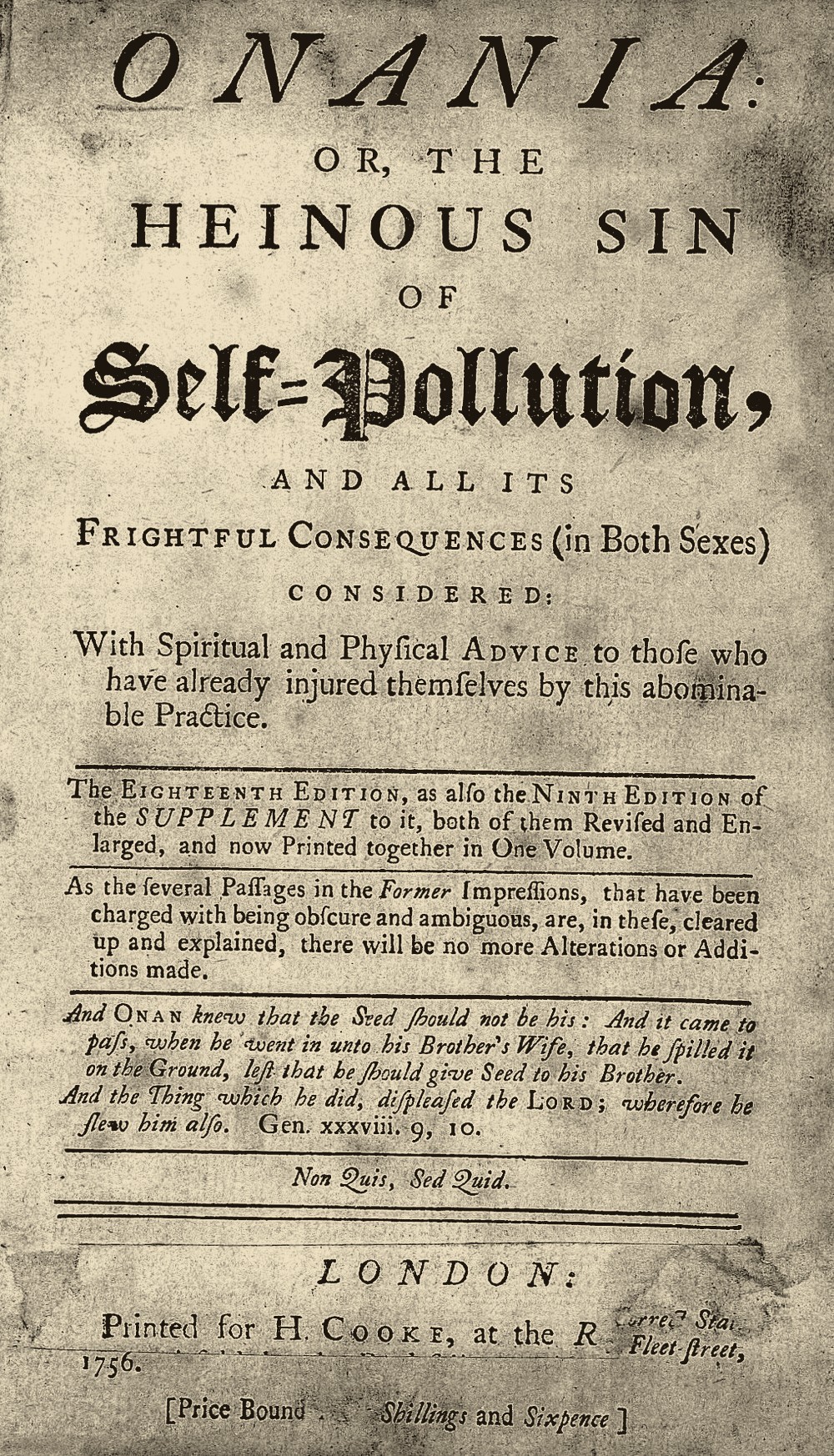
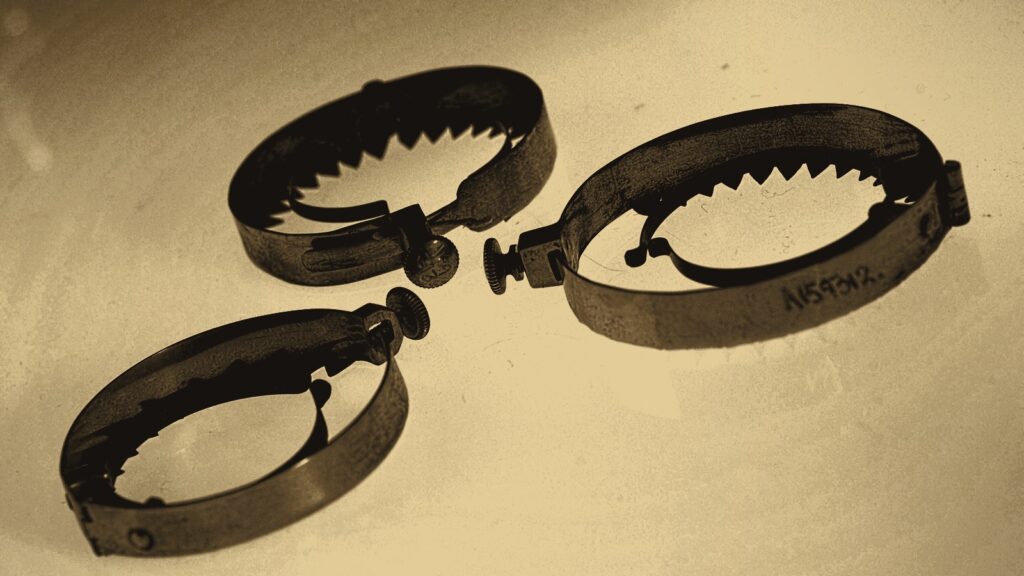
A London pamphlet called Onania first appeared in the early 1700s. It promised readers the “frightful consequences” of self-pollution and sold edition after edition. By the late 1800s the worry had turned mechanical. Toothed metal rings like the ones at the top of this post were made to stop men touching themselves, and some asylums used them. Fear of masturbation is old. Only the packaging changes.
Today the Catholic Church teaches that masturbation is a grave disorder, reasoning from its wider view of sex rather than from Onan alone.⁸ Many Protestant churches in Northern and Western Europe do not treat it as a sin.
Other faiths vary too. Traditional Jewish law forbids “wasting seed” though scholars debate whether that rule comes from the Bible itself or later rabbis. Most Islamic jurists consider it forbidden or discouraged. A minority (including scholars in the Hanbali school) have permitted it as the lesser evil when the alternative is sex outside marriage. In Buddhism the rule against it is explicit for monks and nuns. The Buddha left no such rule for laypeople.
If your faith asks you to abstain that’s a choice to respect. It’s a spiritual choice though. Not a medical one.
So why do so many men feel it’s harming them?
This is where the research gets fascinating. Some men do report that masturbation feels like a problem for them. That feeling is real. The question is where it comes from.
The clearest clue comes from research on porn, which has been studied more. A 2018 study led by psychologist Joshua Grubbs examined the data from several studies on men who felt addicted to porn.⁹ The strongest predictor of feeling addicted wasn’t how much porn they used. It was the gap between what they were doing and what they believed was right. In plain terms the distress came mainly from the clash between behaviour and belief.
A 2020 study from the University of Mainz then looked at masturbation itself and found the same pattern.¹⁰ Of more than 1,000 people surveyed most had tried to stop at some point. Wanting to quit was linked mainly to seeing masturbation as unhealthy and to religious and personal values. It was not linked to how often people were actually doing it.
That matters. It means the advice itself may be part of what makes men feel unwell. Tell a man every day that something normal is damaging him and he will start to feel damaged.
Your own pleasure is nothing to feel guilty about
Here’s what I’d want every man reading this to hear. Enjoying your own sexuality is not, in itself, something to feel guilty about. That’s true with a partner and it’s true alone.
With a partner their feelings matter and need to be part of the picture. Alone there is no one to hurt. The research shows no physical harm and some real benefits. Masturbation is also how most of us learn what we like. That knowledge makes partnered sex better, not worse.
There’s a quieter benefit too. A man who is comfortable taking care of his own lust is under less pressure. He doesn’t have to leap into the first relationship that comes along just because he’s so aroused he could burst. He can wait for someone he actually wants to be with.
What about your mind?
So far this has been mostly about the body. What about psychological reasons to stop?
The research here is thinner and mostly surveys. But nothing in it suggests masturbation harms mental health in itself. If anything it points the other way. A 2019 Australian survey of 778 adults found that people who had an orgasm through masturbation before bed reported falling asleep faster and sleeping better.¹¹ Many people also use it to unwind and take the edge off stress. Those are self-reports, not proof. They’re still a long way from harm.
The psychological risks are real but specific. One is the guilt we’ve just covered. Another is using masturbation as the only way to escape boredom or loneliness or low mood, so the feeling underneath never gets dealt with. A third is secrecy that leaves a partner feeling shut out. In each case the problem is the pattern around it, not the act. So it’s worth asking yourself one honest question now and then. Am I doing this because I want to or because I’m avoiding something?
When it can become a real problem
There is a genuine condition here and it deserves a straight description. The World Health Organization recognises compulsive sexual behaviour disorder.¹² The key features are loss of control and real harm. Repeated failed attempts to cut down. Neglecting work or relationships or health. Carrying on despite clear damage.
Notice what isn’t on that list. A number. There is no frequency that makes masturbation a disorder. Once a week can be a problem for one man. Once a day can be perfectly healthy for another. It’s about control and consequences, not counting.
Slow down and enjoy the ride
Two smaller physical points are worth knowing. Rough technique can cause chafing or soreness, so ease off and use lubricant. And there’s early and limited evidence that an unusually tight grip may make it harder to reach orgasm with a partner. If that sounds familiar varying your technique is a reasonable experiment.
The bigger shift is patience. Many men treat masturbation as a sprint to the finish. Quick and functional and done. Try the opposite. Take your time. Let the pleasure build and linger. Back off when you get close and let it rise again. The journey is as good as the destination when you let it be.
Sex therapists have used this stop-start approach for decades to help men who come sooner than they’d like. So slowing down alone is more than an indulgence. It’s practice for better sex with a partner.
The bottom line
There’s no good scientific evidence that masturbation harms men’s bodies. The testosterone claim rests on a one-day spike from a study that has been retracted. And above a normal level more testosterone doesn’t bring more lust anyway. The erection claim is not supported by the larger surveys. Meanwhile the best evidence we have links regular ejaculation to a lower risk of prostate cancer and to healthier sperm.
So here’s what I’d do with this. If solo lust is part of your life and you enjoy it there’s no medical or psychological reason to stop. Ejaculating several times a week sits comfortably within what the research associates with good prostate and sperm health. Take your time and enjoy it. If you’re trying to conceive aim for every day or two. And if you’ve tried stopping because of something you saw online and felt worse for it, that may be the clash with the advice talking rather than your body.
One clear exception. If masturbation feels out of your control or is crowding out work or sleep or relationships, speak to your doctor or a qualified sex therapist. That’s about control, not frequency. And it responds well to help.
Women hear their own version of this advice. The science on female masturbation has some surprises of its own. That’s my next post.
Curious as ever,
Pascal
References
- Jiang M, Xin J, Zou Q, Shen JW. A research on the relationship between ejaculation and serum testosterone level in men. Journal of Zhejiang University Science. 2003;4(2):236-240. Retracted 2021. https://doi.org/10.1631/jzus.2003.0236
- Wu FCW, Tajar A, Beynon JM, et al. Identification of late-onset hypogonadism in middle-aged and elderly men. New England Journal of Medicine. 2010;363(2):123-135. https://doi.org/10.1056/NEJMoa0911101
- Landripet I, Štulhofer A. Is pornography use associated with sexual difficulties and dysfunctions among younger heterosexual men? Journal of Sexual Medicine. 2015;12(5):1136-1139. https://doi.org/10.1111/jsm.12853
- Rider JR, Wilson KM, Sinnott JA, Kelly RS, Mucci LA, Giovannucci EL. Ejaculation frequency and risk of prostate cancer: updated results with an additional decade of follow-up. European Urology. 2016;70(6):974-982. https://doi.org/10.1016/j.eururo.2016.03.027
- Xi Q, Kong Q, Lv X, Dai R, Yu Y. Impact of ejaculation frequency on semen parameters and DNA fragmentation: a cross-sectional study. Reproductive Biology and Endocrinology. 2025;23(1):100. https://doi.org/10.1186/s12958-025-01439-3
- World Health Organization. WHO Laboratory Manual for the Examination and Processing of Human Semen. 6th edition. Geneva: WHO; 2021.
- The Bible. Genesis 38:6-10.
- Catechism of the Catholic Church. Paragraph 2352.
- Grubbs JB, Perry SL, Wilt JA, Reid RC. Pornography problems due to moral incongruence: an integrative model with a systematic review and meta-analysis. Archives of Sexual Behavior. 2019;48(2):397-415. https://doi.org/10.1007/s10508-018-1248-x
- Zimmer F, Imhoff R. Abstinence from masturbation and hypersexuality. Archives of Sexual Behavior. 2020;49(4):1333-1343. https://doi.org/10.1007/s10508-019-01623-8
- Lastella M, O’Mullan C, Paterson JL, Reynolds AC. Sex and sleep: perceptions of sex as a sleep promoting behavior in the general adult population. Frontiers in Public Health. 2019;7:33. https://doi.org/10.3389/fpubh.2019.00033
- World Health Organization. International Classification of Diseases, 11th Revision (ICD-11). Code 6C72: Compulsive sexual behaviour disorder.
Featured image: Male anti-masturbation devices, late 19th century. Wellcome Collection. CC BY 4.0.
The content on this site is for informational purposes only and does not constitute medical advice. Always consult a qualified doctor before starting any supplement, particularly if you are taking prescription medication.